
Mars Bleu: prevention for the screening of colon cancer
Colorectal cancer: prevention and screening
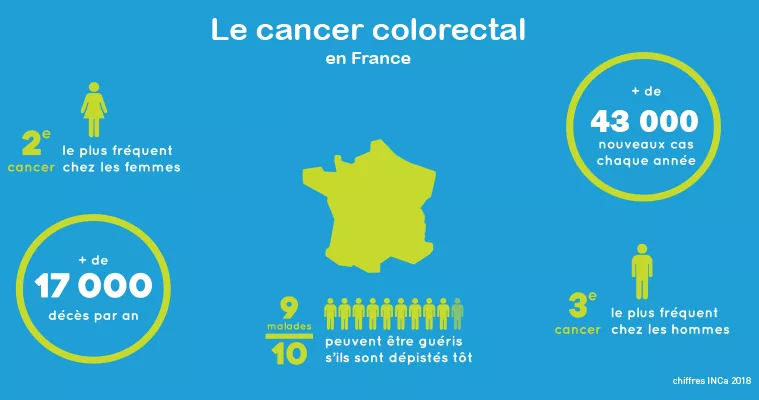
Colorectal cancer affects 43,000 people (approximately 23,000 men and 20,000 women) in France each year and is responsible for more than 17,000 deaths per year. Mars Bleu (Blue March) is the month dedicated to colorectal cancer screening.
Detected early, colon cancer can be cured in 9 out of 10 cases. Thanks to immunological tests, it is now much easier to detect colorectal cancer. It is a test to be performed at home, fast and painless. It allows your sample to be sent directly to the laboratory to establish an early diagnosis.
Awareness raising for colorectal cancer screening: MARS BLEU
Mars Bleu is the annual event organized jointly by the Ministry of Health, the National Health Insurance, and the National Cancer Institute, to raise awareness of colorectal cancer screening. Set up since 2009, the colorectal cancer screening awareness campaign is intended for women and men aged 50 to 74 years presenting no risk factors. The persons concerned receive a letter every two years inviting them to collect a screening test from their doctor.
This year, in a context of health crisis, the cancer prevention and screening awareness campaign is particularly important. Indeed, it is essential to avoid delays in management and to establish an early diagnosis to improve the chances of cure.
For reminder, in 2020 the League against Cancer indicated that nearly 93,000 cancer diagnoses could not be established because of the Covid-19 pandemic.
Cancers in the pelvic area: screening and information
On this occasion, Doctor Adam Vardi wishes to inform you about the various cancers affecting the pelvic area. Indeed, it is important to be screened for all urological cancers too. The aim of screening is to look, in an apparently healthy population, for an undiagnosed or asymptomatic disease.
In urology, four principal types of cancers are encountered:
- Prostate cancer
- Bladder cancer
- Kidney cancer
- Testicular cancer
Prostate cancer screening in Paris
The prostate is a male gland that produces a fluid that enters the composition of semen. It is the seat of the development of the most frequent cancer in France in men. Although rare before 50 years of age, the incidence of prostate cancer increases progressively with age. It has been recognized that family history is a risk factor for prostate cancer.
Screening for prostate cancer is done in two separate ways: the measurement of the PSA level in the blood and the digital rectal examination. PSA is an English acronym standing for “Prostate Specific Antigen”; it is a protein naturally produced by the prostate. An abnormality in the values of your PSA level does not necessarily mean prostate cancer but represents a good indicator for diagnosing a disease affecting the prostate, such as an infection, or an adenoma (increase in prostate size).
Bladder cancer screening in Paris
The bladder is a pouch that receives the urine produced by the kidneys. This extensible pouch measures on average 6 centimeters long and 5 centimeters wide. Several factors favor the development of bladder cancer such as tobacco consumption, exposure to certain chemical agents, and others. It should be mentioned that the presence of blood in the urine allows bladder cancer to be suspected. Other symptoms can alert your doctor, such as frequent urge to urinate or burning sensation when urinating (excluding cases of urinary infection or stones that may have been detected).
To screen for bladder cancer, several examinations can be performed:
- An ultrasound of the entire urinary system.
- A urinary examination to look for cancer cells in your urine.
- A cystoscopy to inspect the inside of your bladder and to perform a biopsy.
Kidney cancer screening in Paris
The kidneys allow the filtration of the blood and the production of urine. Their role is to purify the body; they function like a filter that separates waste from our blood and transforms it into urine. In addition, the kidneys regulate and maintain the balance of water and minerals in your body.
Certain factors are associated with kidney cancer such as tobacco use, obesity, or long-term dialysis treatments.
Screening for kidney cancer is most often offered to members of families affected by a hereditary form of kidney cancer.